Three tricks out of five
Euchre is a fast for two teams of two. Each hand has just five . One team picks the suit and must then win at least three of them.
Two jacks, the and the , are the strongest cards in the game.
Choose trump, then win at least three of the five tricks with your partner. The two black or two red jacks rule the hand.
Euchre is a fast for two teams of two. Each hand has just five . One team picks the suit and must then win at least three of them.
Two jacks, the and the , are the strongest cards in the game.
Take a standard deck and keep only the 9, 10, jack, queen, king and ace of each suit: 24 cards. Outside trump, each suit ranks from ace (high) down to 9.
Four players form two , partners sitting opposite. You and North play against West and East.
The dealer gives each player five cards, clockwise, in two rounds: traditionally a packet of three and then two, or two and then three. Some groups simply deal one at a time.
In this example East deals, so you are on the dealer’s left. Four cards are left over; they go face down in the middle.
The dealer turns the top card of the four left over face up. This suggests the trump suit.
The up-card is the 10 of hearts. Will hearts be trump? That is up to the players.
Starting left of the dealer, each player in turn either passes or : accepts the up-card’s suit as trump. The dealer, speaking last, can accept it too.
You speak first. You hold the jack of hearts, the jack of diamonds and the ace of hearts, so you say “I order it up”. Hearts are trump. You and North are now the , who must win at least three tricks.
Once trump is ordered up, the dealer adds the up-card to their hand and discards one card face down. The dealer always gets the up-card, whoever ordered it up.
East takes the 10 of hearts and discards the 9 of spades.
Tip for dealers: discard your only card of a suit. Then you can trump that suit later.
Suppose instead that all four players had passed. The dealer turns the up-card face down, and a second round starts left of the dealer. Now each player may pass or name any suit except the up-card’s suit: here spades, diamonds or clubs.
If all four pass again, the cards are thrown in and the next player deals.
Many tables play “stick the dealer”: in round two, the dealer may not pass and must name a suit.
A second chance before the redeal.
The player left of the dealer the first trick: that’s you. Everyone must if they can. The highest trump wins; without a trump, the highest card of the suit led. The winner leads next.
You lead the jack of hearts. West has no hearts and throws the queen of diamonds. North and East must follow with hearts. Your jack wins: it is the highest trump of all.
Trumps rank in a special order. The jack of the trump suit is the , the highest card. The other jack of the same colour is the , second highest. Then come ace, king, queen, 10 and 9 of trump.
With hearts as trump, the jack of diamonds becomes a heart for every purpose. Diamonds have only five cards this hand: ace, king, queen, 10 and 9. If diamonds are led and your only “diamond” is that jack, you do not have a diamond.
One jack quietly changes suit.
A player who made trump may announce that they are , after trump is fixed and before the first lead. Their partner puts their cards face down and sits out the hand.
Had you gone alone with this hand, North would lay down their cards and West, on your left, would lead first. Win all five tricks alone and your team scores 4 points.
Many tables also let a defender go alone. A lone defender who euchres the makers scores 4.
After five tricks, one team scores:
| Makers win 3 or 4 tricks | 1 |
| Makers win all 5 (a march) | 2 |
| Lone maker wins all 5 | 4 |
| Makers win fewer than 3 | 2 to the defenders |
You win the first three tricks with the right bower, the left bower and the ace of hearts. West takes the fourth with the ace of spades, East the last with the ace of diamonds. Three tricks: 1 point for you and North.
When the makers fail, they are .
The deal passes to the left after each hand. The first team to reach 10 points wins the game.
Players often keep score with a spare 6 and 4 from the deck, turning and sliding one over the other to show the points.
Point at a dot to see why it matters
The right bower is the jack of the trump suit, the highest card. The left bower is the other jack of the same colour, the second-highest trump. The left bower counts as a trump, not as its own suit.
Five to each of the four players, usually in packets of three and two. Four cards are left over, and the top one is turned face up.
The team that chose trump won fewer than three tricks. The other team scores 2 points.
The up-card is turned down and there is a second round in which players may name any other suit. If all pass again, the hand is thrown in and the next player deals, unless you play stick the dealer.
10 points is standard. Some groups play shorter games to 5 or 7.
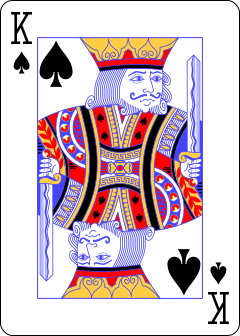 The classic
The deck most people picture. Poker size, standard faces, shuffles well. If you buy one deck, make it this.
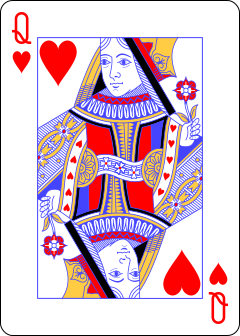 Lasts for years
Two 100% plastic decks in a hard case. Washable and hard to bend, and a double deck is what Canasta and Spider need.
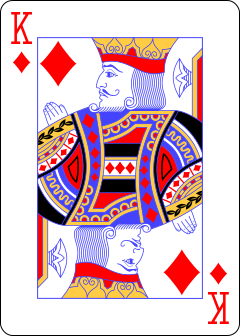 Easy to read
Extra-large numbers and suits. Readable across the table, for kids learning their first game and grandparents alike.
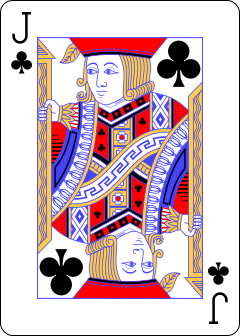 The British classic
The pack found in British homes for generations. Paper cards with a linen finish that fan and shuffle smoothly.
 The gift
A luxury deck with a navy and gold tuck box. The one to give, or to bring out when the good whisky is poured.
Avoid the hearts and dodge the queen of spades.
4 players · 45 min · 10+Bid your tricks with a partner. Spades beat everything.
4 players · 1 hr · 10+The classic partnership trick game. Win the most tricks with your partner.
4 players · 30 min · 10+