Draw, meld, discard
Rummy is the family behind Gin and Canasta. Every turn you draw a card, lay down and if you can, then discard one. The first player to get rid of all their cards wins the round.
Rummy is the family behind Gin and Canasta. Every turn you draw a card, lay down and if you can, then discard one. The first player to get rid of all their cards wins the round.
Use a standard 52-card deck without jokers. In this example two players play: you and North.
| 2 players | 10 each |
| 3 or 4 players | 7 each |
| 5 or 6 players | 6 each |
Put the rest face down as the and turn its top card face up to start the .
The player left of the dealer starts. Take either the top card of the stock or the top card of the discard pile.
The discard pile shows the queen of spades. You hold two queens, so you take it.
You may now put melds face up on the table:
You lay down three queens and the 5, 6 and 7 of hearts.
Aces are usually low (A-2-3). Some tables also allow Q-K-A: agree before you start.
You may also : add cards from your hand to melds already on the table, yours or your opponent’s. Your 8 of hearts extends the run.
Finish your turn by putting one card face up on the discard pile. You may not discard the card you just took from the discard pile.
If all the cards left in your hand fit into melds, you may lay them down and go out without a final discard.
Your discard is their gift.
If you lay down your whole hand in one turn, without having melded or laid off before, you go rummy. The other players pay you double.
Picture a different hand: three kings, the 5, 6, 7 and 8 of diamonds and three 10s, all laid down at once, with the 3 of diamonds as your last discard.
Patience pays double here.
When a player goes out, the others count the cards left in their hands and the winner scores the total:
| King, queen, jack | 10 |
| Ace | 1 |
| 2 to 10 | face value |
North is left with a king, a 9 and a 3: you score 22.
Deal again and keep a running total. The first player to reach the target your table agrees on, for example 100 points, wins.
Point at a dot to see why it matters
Ten each with two players, seven each with three or four, and six each with five or six.
A set of three or four cards of the same rank, or a run of three or more cards in a row in the same suit.
Laying down your whole hand in one turn without having melded or laid off before. The other players pay double.
 Lasts for years
Two 100% plastic decks in a hard case. Washable and hard to bend, and a double deck is what Canasta and Spider need.
 The classic
The deck most people picture. Poker size, standard faces, shuffles well. If you buy one deck, make it this.
 Easy to read
Extra-large numbers and suits. Readable across the table, for kids learning their first game and grandparents alike.
 The British classic
The pack found in British homes for generations. Paper cards with a linen finish that fan and shuffle smoothly.
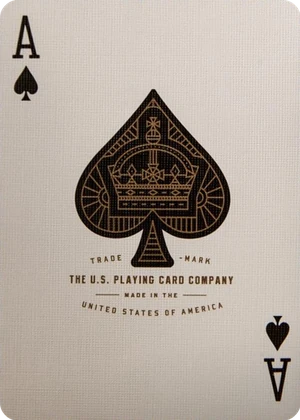 The gift
A luxury deck with a navy and gold tuck box. The one to give, or to bring out when the good whisky is poured.
Two cards of your own, five shared, one best hand.
2 to 10 players · 1 hr · 12+Avoid the hearts and dodge the queen of spades.
4 players · 45 min · 10+Bid your tricks with a partner. Spades beat everything.
4 players · 1 hr · 10+