1. Home
  2. Games
  3. Spider Solitaire

Spider Solitaire

Players
1
Deck
2 × 52 cards, no jokers
Level
Hard
Time
About 30 minutes

Two decks, ten columns. Build down from king to ace in one suit, eight times, until the table is empty.

At a glance

Eight runs, king to ace

Spider is a demanding solitaire played with two decks. You stack cards downwards in ten columns until you have a from king to ace in one suit. A full run leaves the table. Clear all eight and you win.

Harder than Klondike, but careful thinking pays off far more.
Setup

Two decks, 104 cards

Shuffle two standard 52-card decks together, without jokers: 104 cards. You need a table with room for ten columns.

This is the classic four-suit game. Cards rank from king (high) down to ace (low).

On a computer you can choose one or two suits instead of four. Fewer suits make runs easier to complete.

The deal

Ten columns, 54 cards

Deal 54 cards into ten columns, the . The first four columns get six cards, the other six get five.

Only the top card of each column is face up; all the others are face down.

Some rule books deal only 50 cards, five to each column, and keep 54 in the stock. The last deal then covers just four columns.

Fifty cards in the stock

The 50 cards left over form the . Put them aside face down. You will deal them onto the columns ten at a time, so the stock lasts for five deals.

A turn

Build down, in any suit

Move the top card of a column onto a card one rank higher, whatever its suit or colour.

You move the 7 of hearts onto the 8 of spades.

Nothing can go on an ace, and a king can only move into an empty column.

Same suit if you can help it.

Turn up the hidden card

When you move the last face-up card off a column, turn the next hidden card face up. It is now in play.

Under the 7 of hearts was the 6 of hearts. It fits on the 7 of hearts. Under that one you turn up the jack of diamonds.

Same suit moves together

You can move several cards at once only when they are a : in order, and all the same suit.

You move the 9 of diamonds onto the 10 of clubs and turn up the 8 of hearts. Now the 7 and 6 of hearts move together onto it. The 8 of spades stays behind: it is a different suit.

An empty column takes anything

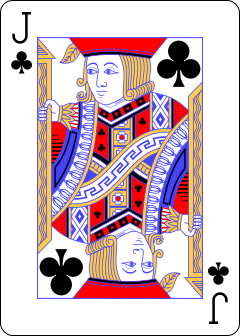
Five more moves clear the ninth column: the 3 of clubs onto the 4 of diamonds, the jack of spades onto the queen of spades, the 5 of spades onto the 6 of hearts, the 10 of hearts onto the jack of diamonds. Last, the ace of clubs goes onto the 2 of clubs.

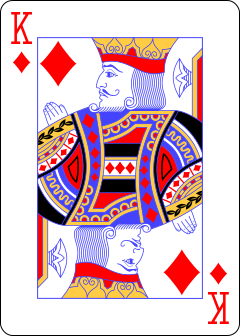
Any card or suited run may go into an . You move the king of diamonds there and turn up the 9 of clubs.

Stuck? Deal ten from the stock

When you run out of useful moves, deal ten cards from the stock: one face up on every column.

You may only deal when no column is empty. Fill empty columns first, with any card.

Deal only when truly stuck.

Special cards

A full run leaves the table

As soon as a column holds a suited run from king all the way down to ace, lift those 13 cards off the table. They are finished.

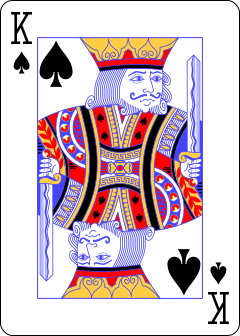
Much later in the game you complete the spades, king to ace, and set them aside.

Scoring

Counting your runs

Spider with real cards has no official score: count the runs you completed. Eight means you won.

Many computer versions start you on 500 points, take 1 off for every move and add 100 for every completed run.

Winning

Clear all eight

You win when all eight runs are off the table and the tableau is empty.

Four-suit Spider is hard, and even careful players lose many games. Shuffle and try again, or practise with fewer suits first.

Point at a dot to see why it matters

Variants and house rules

One suit
All 104 cards are spades, so every downward stack is a suited run. The usual beginner’s game on a computer.
Two suits
Spades and hearts only. Harder than one suit, far easier than four.
Spiderette
A one-deck version with seven columns laid out as in Klondike.

Tips from the table

  1. Build in the same suit whenever you have a choice: mixed stacks are hard to move later.
  2. Empty a column before you deal from the stock: an empty column is your most flexible tool.
  3. Turn up hidden cards early, starting with the columns that have the most face-down cards.

Spider Solitaire: quick answers

  • How do you set up Spider solitaire?

    Shuffle two decks (104 cards). Deal 54 cards into ten columns: six cards in each of the first four, five in the others, top card face up. The other 50 cards are the stock.

  • Can you put any card on another in Spider?

    You can put any card on a card one rank higher, regardless of suit. But only runs of the same suit can be moved together.

  • When can you deal from the stock in Spider?

    Whenever you like, as long as no column is empty. You deal one card face up onto each of the ten columns.

  • What goes in an empty column in Spider?

    Any card, or any run of cards in the same suit. It doesn’t have to be a king.

  • What is the difference between one-suit, two-suit and four-suit Spider?

    The number of suits in play. With one suit every run matches, which makes it the easiest; four suits is the classic and hardest version.