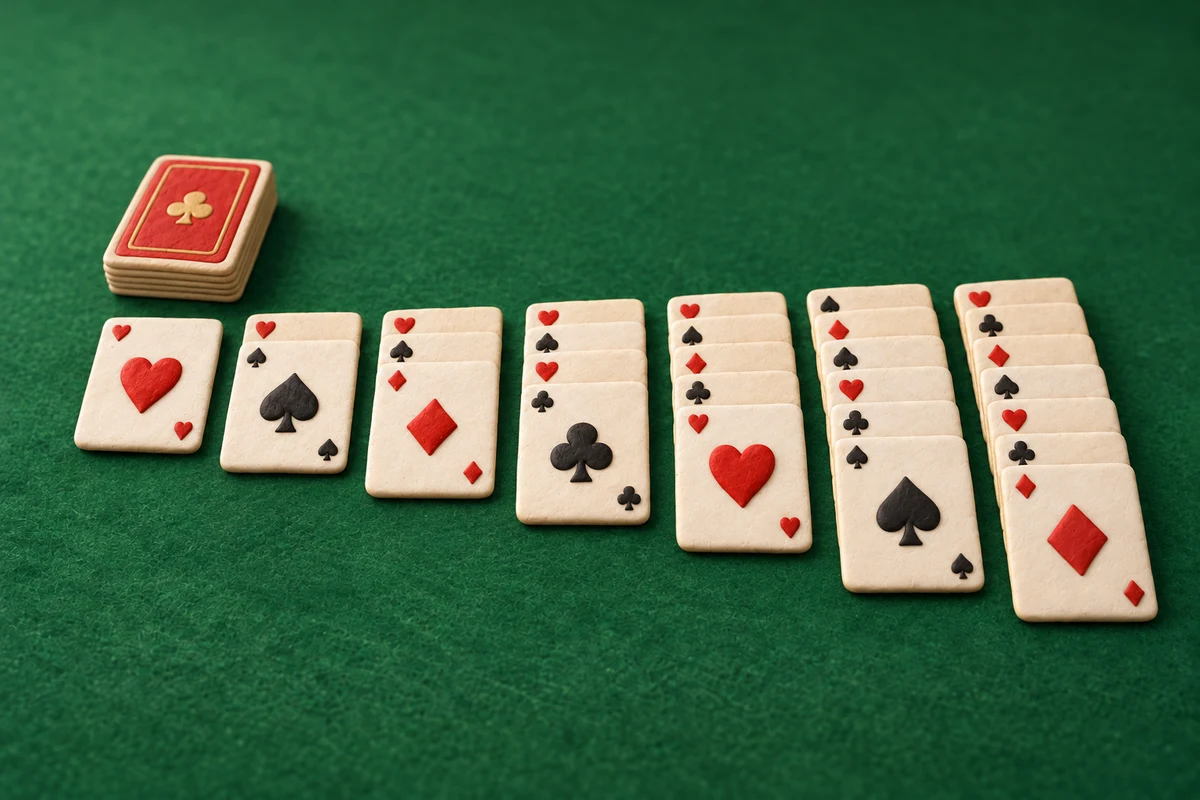
Both are games of patience for one player, and both build columns downwards. Klondike sends the cards up to four foundations, one per suit. In Spider there are no foundations to build: you complete runs from king down to ace in one suit, and each finished run leaves the table.
| Klondike Solitaire | Spider Solitaire | |
|---|---|---|
| Cards | One 52-card deck | Two 52-card decks shuffled together: 104 cards |
| Layout | 7 columns of 1 to 7 cards | 10 columns: 54 cards, the rest is the stock |
| Build down | In alternating colours: a red 6 on a black 7 | In any suit, but only runs in one suit move together |
| Stock | Turn three cards at a time onto a waste pile | Deal ten at once, one on each column |
| Empty column | Only a king may move in | Any card or suited run may move in |
| You win when | All 52 cards are on the foundations | All eight suited runs are complete |
| Level | Easy | Hard |
| Time | About 10 minutes | About 30 minutes |
Choose Klondike Solitaire if
- you want a quick game with one deck
- you are learning solitaire
- you like a game you can often win
Choose Spider Solitaire if
- you have two decks and a big table
- you enjoy long planning
- Klondike has started to feel too easy
With real cards, Spider needs a lot of room: ten columns grow long. A kitchen table works; a tray table does not.
Klondike needs one standard deck, Spider two. Ours: Bicycle Standard →